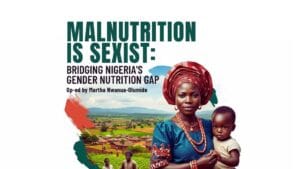
Malnutrition Is Sexist: Bridging Nigeria’s gender nutrition gap
There has long been a painful pattern in the average Nigerian home: mothers and daughters eat last, and they eat the least. What many accept as harmless tradition is, in truth, a quiet injustice with devastating impact.
At least 7.3 million adolescent girls and women are under-nourished, a figure that has jumped 30 percent in just three years. By comparison, anaemia which is the most common sign of micronutrient deprivation affects well under one-quarter of adult men, making clear that this crisis is driven far more by gendered food rules than by an overall lack of food.
Deep-rooted inequities push women to the edge of nutrition, leaving them anaemic, stunted, and facing dangerous pregnancies that bring weaker babies into a cycle of poor health. This burden ripples through families and whole communities. Nigeria’s nutrition emergency is anything but neutral, it strikes women and girls first and hardest. Until we name it for what it is, a gendered fight for survival, we will keep underestimating the true cost of our silence.
Around the world, malnutrition hits women hardest. More than one billion women do not get the nutrients they need, making up 60 percent of all undernourished people twice the share of men. Here in Nigeria, the toll is stark: nearly six in ten girls aged 15–19 is underweight, and because many mothers begin pregnancy malnourished, about half of all child stunting takes root before birth or within a baby’s first six months, sealing the next generation into the same cycle of poor health.
Meanwhile, in Nigeria’s cities, a different face of hunger is emerging. Pressed for time and cash, many working women rely on cheap, fast foods, and white bread, rather than cook balanced meals. One similar study from Brazil found 20 percent of women did not have time to cook and had to rely on fast food, while in Iran many women reported skipping meals (even lunch) to continue working for income.
The payoff? A “double burden” of malnutrition: persistent anaemia and nutrient deficiencies on one hand and rising obesity and diet-related disease on the other. More than 55 percent of women of reproductive age are anaemic, deprived of essential iron, yet one-third are overweight or obese as empty calories flood their diets. Diabetes and hypertension are climbing too; roughly one in four adult women now has diabetes. In other words, women are battling both hidden hunger and diet-related disease at once. When the food system ignores women’s needs, entire families pay the price.
Beyond cultural norms, gender barriers (including economic, social, and systemic) drive the malnutrition that hits Nigerian women and girls hardest. The CGIAR Gender and Food Systems framework shows that unequal rules are woven into every stage of food production and distribution, and Nigeria illustrates this vividly: although women supply about 70 percent of farm labour, only one in ten owns land, and fewer than 23 percent can secure formal credit. Lacking titles and loans, women cannot invest in better seeds or equipment, so they harvest less, earn less, and feed their families from thinner reserves.
At the systemic level, women are largely absent from the tables where agriculture, health, and budget decisions are made. Nigeria’s National Gender Policy (2021–2026) and its nutrition action plans mention women’s empowerment, yet those promises rarely to translate into action.
The funding record confirms the gap. In 2021, the Federal government allocated only ₦840 million less than 0.2 percent of the national budget to all nutrition programmes, disbursed barely half of it, and directed only a token share to women and girls. Meanwhile, malnutrition drains an estimated US $56 billion a year, about 12 percent of GDP, through lost productivity, higher health costs, and lower lifetime earnings. When a girl begins life under-fed, she is more likely to leave school; as a stunted woman she earns less, and her malnourished pregnancy perpetuates the cycle. Thus, the very people who plant and cook the nation’s food have the least control over it and the entire country pays the price.
Focusing on women’s nutrition is not charity; it is smart economics. Global evidence shows that when women control income and decisions, household diet quality rises by about 15 percent and child stunting drops by up to 6 percent points. A pilot in southwest Nigeria found that women who received leadership training boosted household vegetable intake by 18 percent within a year.
Put simply, when women have resources and a voice, hidden hunger becomes shared prosperity. However, ignoring them is costly: 55 percent of Nigerian women of reproductive age are anaemic, draining productivity and driving up health-care bills for everyone. Good diets for women, especially during pregnancy are the first defence against both under-nutrition and the diet-related diseases now climbing nationwide. If Nigeria hopes to end malnutrition in all its forms, it must put girls’ and women’s nutrition at the centre of policy.
Sceptics raise three main objections, and each is disproved by the evidence. First, they insist that deep-rooted food norms cannot be changed. Yet long-term studies from Bangladesh, Malawi, and other countries show that targeted behaviour-change programmes can alter intrahousehold food-sharing in less than two years, proving traditions are not fixed. Second, they argue that scarce funds should address overall poverty before zooming in on women.
However, World Bank cost-benefit analyses reveal that every naira spent on women-centred nutrition delivers some of the highest economic returns available, outpacing many broad poverty measures. Third, critics worry that focusing on women sidelines men and boys. USAID’s SPRING research shows the opposite: when women gain resources and decision-making power, the entire household including husbands and sons eats better. In short, each reservation has been tested, and the data consistently favour investing in women’s nutrition.
Nigeria’s gendered nutrition crisis demands immediate, coordinated action across all levels of society: Federal and State Governments: Increase budget allocations for nutrition programmes, with specific targets for women and girls. Ensure Ministries of Health, Agriculture, and Women’s Affairs implement coordinated, women-centred nutrition policies.
Local Governments and Community Leaders: Promote behaviour-change initiatives to address intrahousehold food inequities. Enlighten fathers, caregivers, and community members on the shared benefits of prioritising mothers’ and daughters’ access to nutritious food.
NGOs, Civil Society, and Development Partners: Support evidence-based interventions such as leadership training for women, nutrition education campaigns, and behaviour-change programmes. Monitor and evaluate programme effectiveness to inform scaling and policy decisions.
Closing the gender nutrition gap is not just a moral obligation, it is critical for maternal and child health, national productivity, and long-term economic development. Every actor, from federal policymakers to local households, must take responsibility to ensure women and girls are nourished, empowered, and set on a path to break the cycle of malnutrition.
Martha Nwanua-Olumide is a biomedical scientist and global health advocate committed to improving health outcomes in low- and middle-income countries (LMICs).